
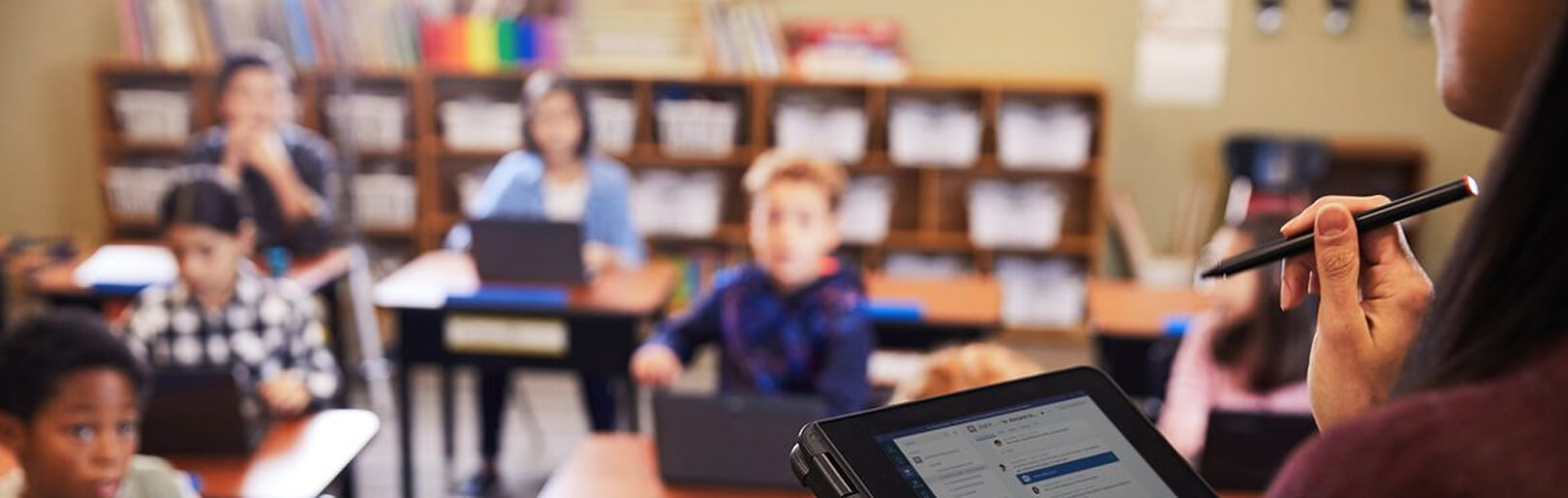
How Teachers Can Adapt Technological Changes in Education
Cybersquare on Dec 31, 2021 11:11:56 AM
Technology continues to have a tremendous impact on almost all areas of life for the modern man. Education is a sector which sees no exception in this rapido of change that is rising up. Although it is easy to think that in some aspects it might look like education has not changed as much in all these years. Children are still following the lecture method of teaching with one teacher addressing a class of around fifty students. While these fundamentals remain to be the same, in many aspects technology has profoundly made a significant change in the overall execution of teaching. One of the most important ones being that technology has greatly improved the accessibility of education to the common people.
Books were difficult to come by in the bad old days, and only a few people among the elite had access to them; this made it extremely difficult for a layman to become educated, even if he wished to.People had to travel afar to receive education or even be subjected to getting even the most basic training, such as mathematics or language, that they would require to live fruitfully in life. But this is not the situation now; people have access to books, texts, and other knowledge methods due to the rise of the internet. Online resources such as MOOCs, podcasts, and other knowledge hubs have greatly contributed to the accessibility of these things. Almost everyone has access to knowledge now thanks to technology. The only thing that keeps them from benefiting from it is their personal choice.
Technology has also made it easier for people to communicate and collaborate. In the past, classrooms were generally solitary places where students could only interact with others in their immediate vicinity. Technology now makes it very easy for people to learn things that they simply could not before. It is possible to learn about the Arctic in a rural classroom in India by following a team of scientists on an excursion in the area as well as reading their blog posts and seeing their images and emailing them questions. Students may learn from others in other classes who are following the same excursion in different states. Wikis and Google documents may be used by students to work on group assignments. As technology allows for new methods of learning, communicating, and collaborating, traditional classroom boundaries are no longer a hindrance.
There are various ways that technology may enhance and improve education, from making it simpler for instructors to generate instructional materials and facilitating new modes of learning and collaboration. Now that smart gadgets can connect to the Internet, we're entering a new era of education where students may learn whenever and wherever they choose. In order to ensure that everyone has access to high-quality education, educational technologists and instructional designers must make the most of the new possibilities presented by technology.
The Union Cabinet adopted the New Education Policy 2020 on July 29, 2020, and it replaced an outdated version of the policy with numerous new concepts. Education and learning are the primary goals of the new policy, which is why it was introduced. The New Education Policy 2020 will have an influence on the CTET and TET certified teachers and the recruiting process in the KVS and NV government education systems after its adoption. But the changes affect not only the teachers in government sectors but the entire constellation of academia. Historically, schools following the CBSE and ICSE syllabuses have been at the forefront of educational change, whether in terms of syllabus or any other method of instruction.This is true in the case of artificial intelligence as well. We had seen that AI had been incorporated into the CBSE skills subjects list as soon as the NEP 2020 was brought into form.
According to the New Education Policy (NEP), AI and AI education are of critical relevance in today's world. According to the strategy, imparting technological capabilities at all educational levels is critical to modernising India's curriculum and ensuring that its students are ready for the AI economy.
The teaching of modern disciplines like Ai Technology and Design Thought will introduce schoolchildren to critical skills including digital literacy, coding, and mathematical reasoning from a young age. Undergraduate programmes will include courses in artificial intelligence, 3-D printing, big data, and machine learning so that graduates will be industry-ready. Core disciplines like machine learning will be available at all institutions as doctorate and masters degree programmes. In addition, institutions may also provide instruction in low-expertise AI value chain jobs such as data augmentation, picture classification, and voice transcription.
The policy has emphasised the symbiotic link between technology and academia in keeping with the national goal of Digital India. Technology teaching and research, as outlined in the National Education Policy (NEP), would be crucial in transforming India's educational system. As part of its bilingual and holistic education aims, the strategy envisages using AI-powered solutions. Students in Indian schools will be encouraged to learn many languages as part of attempts to improve Natural Language Processing (NLP) skills for the country's many languages. A child's life skills training will also be tracked and recorded using AI in order to generate a comprehensive report card.
This is why we are bringing about training for every teacher and lecturer in the field of academia absolutely free of cost! The free AI training can be attended by CBSE schools teachers as well as CS Faculties & HOD’s in association with in order to bridge the gap between popular perceptions of AI and what it actually is. This training will be beneficial to faculties who want to improve their general grasp of AI in general and for those who wish to incorporate AI into their teaching practise and student's learning. The one and a half hour holistic training starts at 06:00 PM IST on December 8th 2021 and those who wish to participate can register here. We look forward to having a fruitful session with you!
CyberSquare. has a wealth of experience in the functioning of programming education for children, as well as how it can be brought about among the children in a way that they understand as a whole, as a pioneer in developing coding for kids initiatives and artificial intelligence curriculum in many parts of the world. If you want to adopt the latest technology in your schools and help your students develop their own projects using the latest technologies, join up with Cyber Square aicoding.school.