

ARTIFICIAL INTELLIGENCE INTEGRATION ACROSS SUBJECTS FOR CBSE CURRICULUM
Cybersquare on Dec 31, 2021 11:11:56 AM
Relevance of Artificial Intelligence
Artificial Intelligence (AI) is the ability of machines to do cognitive tasks such as thinking, perceiving, learning, problem solving, and decision making. It is based on how individuals use their brains to comprehend, learn, reason out, and make decisions.
According to the World Economic Forum, Artificial intelligence (AI) is the software engine that fuels the Fourth Industrial Revolution. Its effects are already being seen in people's homes, businesses, and political systems. It will soon be driving automobiles, stocking warehouses, and caring for the young and elderly in its embodied form of robots. It has the ability to solve some of society's most serious problems, but it also comes with its own set of problems, including incomprehensible "black box" algorithms, unethical data use, and potential job displacement. As machine learning (ML) advances, the scope and scale of AI's deployment across all aspects of daily life expands, and as the technology learns and changes on its own, In order to develop confidence, multi-stakeholder engagement is essential to maximise accountability, openness, privacy, and impartiality.
Artificial intelligence (AI) is a sort of intelligence, as well as a technology and a subject of study. The theory of artificial intelligence (AI) and the development of computer systems (both machines and software) can execute activities that would typically need human intelligence. Artificial Intelligence (AI) encompasses a wide range of topics and applications, and it is projected to have a significant impact on all fields in the future. Overall, the goal is to create robots and algorithms that are capable of doing computational tasks that would otherwise necessitate human-like brain capabilities.
History of AI
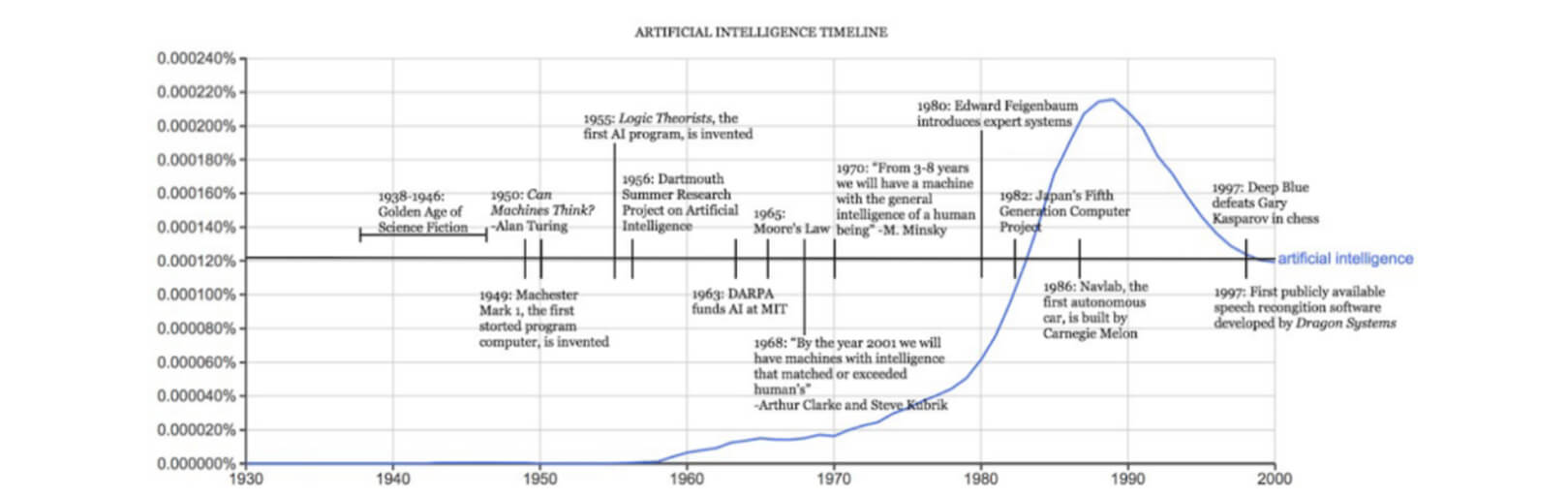
The origins of current AI can be traced back to attempts by classical philosophers to represent human thought as a symbolic system. However, the science of AI was not formally created until 1956, when the name "Artificial Intelligence" was adopted at a meeting at Dartmouth College in Hanover, New Hampshire. The graph below effectively demonstrates why AI is a living science, what the ups and downs in the AI journey have been, and how AI has developed in this domain from 1930 to 2000.
AI in EDUCATION?
An excellent academic system has the dual role of developing a country's human resources. One, new generations must be educated in such a way that they are "life-ready" and contribute positively to their country's progress and enrichment. Second, they must be exposed to such learning settings with the assistance of current tools and knowledgeable trainers in order for their learning results to be maximized and tailored to each learner's unique potential. In order for modern education to achieve its aims of making pupils ‘AI-Ready,' it is critical to understand what K-12 kids must experience and face on a daily basis.
AI is at the heart of a wide range of applications around the world. It encompasses and develops a wide range of capabilities that can be used in a variety of fields of study and operations.
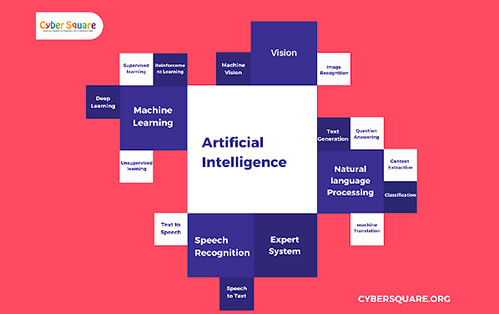
Many of the technologies and underlying principles have a strong connection to the learning and teaching process at the elementary and secondary school levels, as well as at the college level. As a result, it is critical that AI not only be included as a subject in school curricula but also serve as a link to the teaching of other subjects at all levels. Many AI-based applications are now accessible to help a learner learn in his or her own unique style and at his or her own speed.
CBSE’s new initiative that encompassing Artificial Education
Making students "AI Aware" or fostering "AI Readiness" is a monumental task. In this approach, the Central Board of Secondary Education has initiated a "twin initiative" with the Ministry of Human Resource Development. The first step is to make AI an elective subject in grades 8, 9, and 10. To begin, schools must submit an application to CBSE and be allowed to offer this course. A Facilitators' Handbook has been created to accompany the AI curriculum for classes 8 and 9. In addition, CBSE is funding comprehensive teacher training for AI education in schools.
The second component of the CBSE project is based on the idea that AI is a Cognitive Science that may be related to a variety of topics that deal with cognition and reasoning. Almost all of the educational subjects would fall within this category. Mathematics, Computing, Neurosciences, Psychology, Physics, Economics, Sociology, Philosophy, Languages, and a variety of other subjects are all covered. As a result, CBSE has ordered that all of its institutions begin integrating AI with other disciplines in grades 1 through 12.
Initiative 1: Artificial Intelligence is pervasive across the world we live in today. Every day, our youthful generation sees several examples of AI in action. As a result, it is critical that today's students study this topic in order to comprehend it and later be able to increase their knowledge for their personal benefit and the benefit of humanity.
Initiative 2: Unlike other disciplines that only investigate and analyze the exterior behaviour of intelligent agents, AI is one of the cognitive science fields that provides tools to generate intelligence. By recognizing this requirement, it has been agreed that all teachers in CBSE schools should become acquainted with current AI expertise and use it to improve the effectiveness and student-centeredness of their subjects' learning. It is envisioned that taking this step would aid in the development of greater knowledge of AI across the teacher and student groups.
What role may AI play in helping teachers in achieving the desired learning outcomes?
As AI schooling solutions advance, it is envisaged that AI will help address learning and teaching gaps, allowing schools and teachers to do more than ever before. AI can improve efficiency, personalization, and provide teachers more time to use their understanding and adaptation, which are unique to humans, to educate in areas where machines would struggle. The education system will be driven towards the optimal outcome for kids by utilizing the greatest attributes of AI robots and teachers. it's essential that our educational institutions expose students to new technologies and how to use them.
Once AI tools are in place, teachers will be able to spend more time in the classroom since they will have more free time. As a result, they may concentrate on student's individual learning methods. So then they can focus appropriately on the issue of acquiring language processing, reasoning, and cognitive modeling skills, having assumed the AI capabilities.
Is AI integration in education beneficial to classroom "Effective Teaching methods"?
Since all cognitive domains of education are intimately connected to the notion of AI, it provides a wealth of chances for student participation that cannot be found in lecturing from textbooks within the confines of the classroom's four walls. AI and machine learning are evolving dynamically in an era termed AI SPRING, and each has the ability to propel the other forward and accelerate the learning frontiers in a synergistic manner, as well as the invention of fresh inventive technologies. It is widely agreed that artificial intelligence (AI) will be the source and cause of improved teaching-learning methodologies in the classroom.
Machine Learning algorithms in the education area have already begun to assist teachers in many parts of the world, particularly in advanced nations, in filling the gaps in the subjects where students are struggling the most. The number of AI-based pedagogical techniques now available is extensive. During her studies, a motivated and enlightened teacher will come across many such tools and techniques that she might advantageously employ from time to time in the interest of her students.
What role do schools play in the success of CBSE's AI-integrated learning directive?
Much of the professional world that today's students will encounter in 10 or 15 years will be based on and derived from AI technologies. As a result, in order to remain relevant in the times they live in, the current generation of young pupils must be exposed to and enabled to understand and implement AI competencies. While they will profit from an AI-enabled world now, they will also need to learn how to recognize and evaluate the obstacles that substantial AI use may cause later in life.
The outcome of CBSE's dual initiatives will be determined by how schools interpret and apply it, as well as how teachers engage with it and organize some of their classes so that students' knowledge of AI is rational. We believe that once the trigger is positive, a huge number of students will go into ‘auto' mode, exploring AI domains and becoming sensitized to AI applications. Some teachers have been noted to have a complex that anything technological is computer-based, and anything computer-based is beyond their grasp or reach. It's worth repeating that once a teacher recognizes the inevitability of AI, everything else falls into place.
Summary
Artificial Intelligence (AI) is a Cognitive Science that has evolved from information derived from fields such as Science, Mathematics, Philosophy, Sociology, and Computing. As a result, any educational institution would be justified in recognizing the need of incorporating AI Readiness to maximize learning across all subjects.
AI is widely acknowledged as the power that will power the global digital economy of the future, and it has assumed geo-strategic significance. A big number of countries are working hard to stay ahead of the curve with policy measures aimed at preparing their youth to function in a world dominated by AI and other new technologies.
AI is identified as an advantage and remedy which provides inclusive economic growth and social development in India's own AI Strategy. In order to "fully harness the potential of AI in a sustainable manner" and make India's future generation "AI ready," the research highlights the necessity of skills-based education (as opposed to knowledge-intensive education) and the relevance of project-related work. From the 2019-2020 school year onwards, CBSE has made Artificial Intelligence an optional subject in Class 9 and has been training teachers on how to incorporate AI into the classroom. To help with this, a training video has been created.
CBSE has recently announced AI as a multi-disciplinary, integrated pedagogical method to improve teaching and learning in grades 6 to 12. This article contains details on the importance of Artificial Intelligence and relevance of bringing Artificial Intelligence across subjects for CBSE curriculum.